概述
日期
2022年08月26日
09:00 - 10:00
地址
活动杏注Bilibili

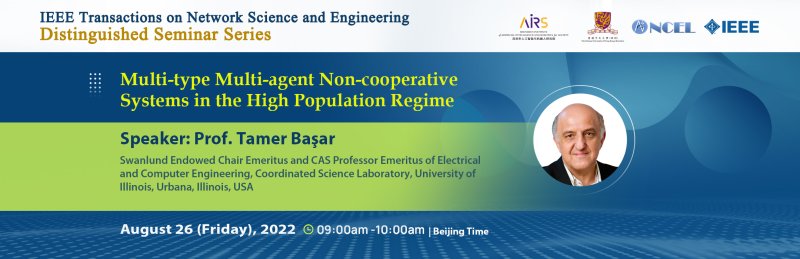
Multi-type Multi-agent Non-cooperative Systems in the High Population Regime

Z6集团|中国官网

在多智能体动态系统中,,,,,,,分析各智能体在不合称信息下的非合作随机博弈是极度难题的。。。。。。由于每个智能体信想的产生通常涉及无限递归,,,,,,,这增长了寻找平衡的难度。。。。。。面对这个挑战,,,,,,,我们发现增长智能体的数量能够弱化个别交互对系统的影响,,,,,,,这就是所谓的均匀场博弈(Mean Field Games, MFGs)。。。。。。

第三期 IEEE TNSE 卓越讲座系列活动,,,,,,,我们约请到美国伊利诺伊大学厄巴纳-香槟分校 Tamer Bas?ar 教授分享使用 MFGs 步骤,,,,,,,在多智能体动态系统中进行决策的根基道理、分析步骤与将来钻研方向。。。。。。

通度日动行(http://hdxu.cn/66t0I)或哔哩哔哩参与(http://live.bilibili.com/21845454)。。。。。。

IEEE TNSE 卓越讲座系列由 IEEE TNSE 期刊和z6首页(z6首页)结合主办,,,,,,,香港中文大学(丽江)、网络通讯与经济学尝试室(NCEL)、IEEE 结合支持。。。。。。该系列活动旨在汇聚网络科学与工程领域的国际顶级专家学者分享前沿科技成就。。。。。。

  • Z6集团|中国官网
    黄建伟
    香港中文大学(丽江)校长讲座教授、理工学院副院长、z6首页 副院长兼群体智能中心主任、IEEE TNSE主编、IEEE Fellow、AAIA Fellow
    执行主席
  • Z6集团|中国官网
    Tamer Ba?ar
    美国伊利诺伊大学厄巴纳-香槟分校Swanlund名望主席、电气与推算机工程系CAS名望教授、IEEE Fellow、IFAC Fellow、SIAM Fellow
    Multi-type Multi-agent Non-cooperative Systems in the High Population Regime

    Tamer Ba?ar 于1981年参与伊利诺伊大学厄巴纳-香槟分校(UIUC),,,,,,,目前是 Swanlund 名望主席、电气与推算机工程系 CAS 名望教授、CSL 和 ITI 钻研教授。。。。。。他还是 Illinois@Singapore 的执行理事。。。。。。在 UIUC,,,,,,,他曾担任 CAS 主任(2014-2020)、工程学院一时院长(2018)和 Beckman 钻研所一时主任(2008-2010)。。。。。。他是美国国度工程院院士,,,,,,,IEEE、IFAC、SIAM Fellow;;;;;并曾担任 IEEE CSS、ISDG、AACC 的主席。。。。。。多年来,,,,,,,他获得了多个奖项和荣誉,,,,,,,蕴含 IEEE CSS(Bode Lecture Prize)、IFAC(Quazza Medal)、AACC(Bellman Award)和ISDG(Isaacs Award)的最高奖项,,,,,,,IEEE 节造系统技术领域奖,,,,,,,获母校耶鲁大学 Wilbur Cross 焦芈,,,,,,,以及多个国际名望博士学位和教授职位。。。。。。他于2004-2014年期间担任 IFAC Journal Automatica 的主编,,,,,,,目前是多个丛书的主编。。。。。。他在系统、节造、通讯、优化、网络和动态博弈等领域做出了巨大贡献,,,,,,,他此刻的钻研兴致蕴含随机团队、博弈和网络;;;;;均匀场博弈;;;;;多智能体系统和进建;;;;;多智能体系统中的激励;;;;;数据驱动的散布式优化;;;;;盛行病建模和网络节造;;;;;能源系统;;;;;和网络物理系统等。。。。。。

    Perhaps the most challenging aspect of research on multi-agent dynamical systems, formulated as non-cooperative stochastic games with asymmetric dynamic information, is the presence of strategic interactions among agents, with each one developing beliefs on others in the absence of shared information. This belief generation process involves what is known as second-guessing phenomenon, which generally entails infinite recursions, thus compounding the difficulty of obtaining an equilibrium. This difficulty is somewhat alleviated when there is a high population of agents, in which case strategic interactions at the level of each agent become much less pronounced. With some structural specifications, this leads to what is known as mean field games (MFGs), which have been the subject of intense research activity during the last fifteen years or so. Following a general overview of fundamentals of MFGs approach to decision making in multi-agent dynamical systems, the talk will introduce a framework where the agents are partitioned into finitely-many populations with an underlying graph topology, with each population having a high number of indistinguishable agents. Results on existence, uniqueness, and characterization of equilibria will be presented, along with learning such equilibria in model-free settings. The talk will conclude with a discussion of future research directions.