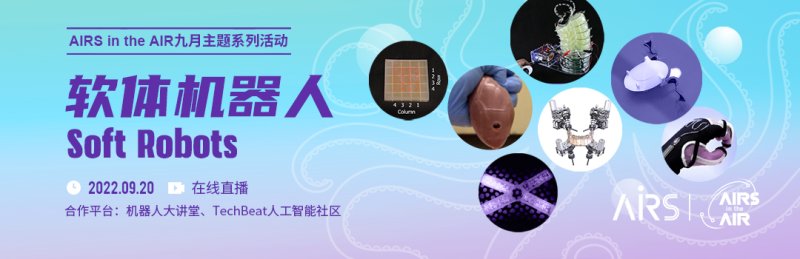
z6首页 in the AIR

概述
日期
2022年09月20日
10:00 - 12:15
地址
Bilibili, Huodongxing

z6首页 in the AIR | Soft Robots (Session 3)

Z6集团|中国官网

Soft robots, composed of soft materials such as rubber, hydrogel, etc., can adapt to unstructured environments and ensure safety when interacting with people, which have attracted lots of attention in recent year.

In Sept. 2022, the Shenzhen Institute of Artificial Intelligence and Robotics for Society (z6首页) invites top scholars from home and abroad to share the most innovative research and profound knowledge in the field of "Soft Robots".

Join the event on Sept. 20 through Huodongxing (http://hdxu.cn/ak8eB) or Bilibili (http://live.bilibili.com/22587709).

z6首页 in the AIR, lecture series launched by z6首页, invites top scholars and experts to share cutting edge technologies and latest trend in the field of AI and robotics, and exploring their industrial applications.

  • Z6集团|中国官网
    Jian Zhu
    Associate Professor at CUHK-Shenzhen, PI at z6首页
    Executive Chair
  • Z6集团|中国官网
    John Madden
    Professor at University of British Columbia
    Soft robot touch: Creating sensation using elastomers

    John Madden is a Professor of Electrical & Computer Engineering at the University of British Columbia in Vancouver, and the director of AMPEL, UBC’s materials science, engineering and devices laboratory. John is known for his work on electroactive polymers (artificial muscle), and work to understand piezoionic mechanisms. He also leads Mend the Gap, an international initiative seeking to use materials solutions to repair the spinal cord after injury.

    Reduced dexterity in machines means delicate tasks such as lighting a match, sewing, interacting gently with a person and handling an egg are a challenge for robots. Here we report on several soft sensors being developed to address this challenge, with applications in robotics, industrial automation, medical devices and interfaces with the nervous system.

    The first is a flexible soft sensor for detecting normal force and shear. Offset capacitive electrodes are used to detect both indentation of the soft, elastomeric sensors, as well as the lateral motion of the top surface relative to the bottom, characteristic of shear. A key is the use of a pillar structure in the dielectric, which increases sensitivity. Stretchable conducting electrodes are made of carbon containing elastomer, stretchable fabric or transparent hydrogels. Initial application to a roller for automated fibre placement and a mat for pressure injury warning are shown.

    Two ionic sensors are also shown. The first ionic sensor is triboelectric, in which charging at the interface between an ionic conductor and a charged surface can produce more than a volt when the interface area is dramatically altered. This version of a triboelectric effect has the potential to be used in generation where high surface area changes and/or high frequency displacements are present. The second uses the piezoionic effect. This is akin to piezoelectrics, but involves the generation of current and voltage in response to pressure gradients. These gradients induce ionic currents. We show that these can generate millivolt level signals combined with currents that directly activate the nervous system, suggesting use in brain-machine interfaces.
    Soft sensors have the potential to be incredibly cheap, cover large surface areas and be incorporated into robots, wearable devices, sports gear and much more. The talk concludes with a discussion of opportunities and challenges.

  • Z6集团|中国官网
    Jianyu Li
    Assistant Professor at McGill University
    Tough bioadhesive technologies for tissue repair and soft robotics

    Dr. Jianyu Li is Canada Research Chair and Assistant Professor in the Department of Mechanical Engineering, and Associate Member in the Departments of Biomedical Engineering and Surgery at McGill University. He graduated from Zhejiang University and obtained a Ph.D. degree in Mechanical Engineering under the supervision of Joost Vlassak and Zhigang Suo from Harvard University. He conducted postdoctoral research on biomaterials with David Mooney at the Harvard Wyss Institute. He is recognized with the Christophe Pierre Research Excellence Award from McGill University, the Wyss Technology Development Award from Harvard University and is listed in Innovators under 35 China by MIT Technology Review. His current research is focused on the design, mechanics, and applications of biomaterials. His works appear in high profile journals such as Science, Nature Reviews Materials, Advanced Materials, etc. They have been covered by the New England Journal of Medicine, JAMA, and many news outlets such as the BBC, the CBC, etc.

    Human body resembles a machine. The joints rotate and the muscles actuate. When broken, the machine can be repaired with glues and tapes. But the human body still calls for bioadhesive technologies, enabling tough and robust adhesion with biological systems. They hold great potential for various tissue repair applications, as well as the development of soft robotics interfacing with the human body. 

    This talk will present the invention and translation of tough bioadhesive technologies developed in my lab. I will first review the design strategies of bioadhesives, as well as the associated challenges and opportunities. I will then synthesize multifaceted design principles into tough bioadhesives, which achieve extremely tough adhesion on diverse tissues, outperforming existing counterparts. As a platform, the tough bioadhesive is further extended for multi-functionality, such as stimulus responsiveness, drug delivery, and electromechanical transduction. The resulting technologies are demonstrated in wound management, surgical devices, and soft robotics. This talk will highlight the synergy of materials, mechanics and bioengineering that could potentially transform medicine and engineering.

  • Z6集团|中国官网
    Shengqiang Cai
    Associate Professor at University of California, San Diego
    Liquid crystal elastomer-based soft robotics

    Shengqiang Cai is currently an associate professor in the Department of Mechanical and Aerospace Engineering and Materials Science and Engineering program at University of California, San Diego. He obtained his Ph.D. degree from Harvard University in 2011. After graduating from Harvard, he spent one year as postdoc at MIT. His research is mainly focused on mechanics of materials, especially soft materials and active materials. Shengqiang Cai has received NSF career award in 2016 and Journal of Applied Mechanics Award in 2020.

    Liquid crystal elastomer shows reversible and large deformation, resulting from the phase transition of mesogens integrated with the polymeric network.  The unique behaviors of liquid crystal elastomer have been recently intensively explored to construct soft robots of various forms. In the talk, I will show several soft robots we built from liquid crystal elastomers. First, I will talk about a light driven multimodal soft robot constructed from an liquid crystal strip with an arch shape, which can crawl, jump and squeeze.  Second, I will present a novel liquid crystal elastomer-based tensegrity robot, which can move along a hexagonal path under light stimulation. Finally, I will discuss our recent studies of the fabrication of electrospun liquid crystal elastomer fiber as artificial muscle.

Time Session Speaker & Topic

10:00-10:45

Keynote Speech

John Madden, University of British Columbia
Topic: Soft robot touch: Creating sensation using elastomers  and hydrogels

10:45-11:30

Keynote Speech

Jianyu Li, McGill University
 Topic: Tough bioadhesive technologies for tissue repair and soft robotics      

11:30-12:15

Keynote Speech

 Shengqiang Cai, University of California, San Diego
Topic: Liquid crystal elastomer-based soft robotics 

Video Archive