Overview
Date
Aug 26, 2022
09:00 - 10:00
Venue
活动杏注Bilibili

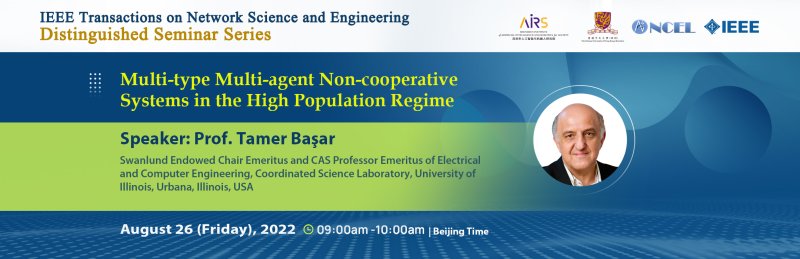
Multi-type Multi-agent Non-cooperative Systems in the High Population Regime

Z6集团|中国官网

IEEE TNSE Distinguished Seminar Series is co-sponsored by IEEE Transactions on Network Science and Engineering (TNSE) and Shenzhen Institute of Artificial Intelligence and Robotics for Society (z6首页), with joint support from The Chinese University of Hong Kong, Shenzhen, Network Communication and Economics Laboratory (NCEL), and IEEE. This series aims to bring together top international experts and scholars in the field of network science and engineering to share cutting-edge scientific and technological achievements.

Join the seminar on August 26 through 活动行 (http://hdxu.cn/66t0I) or Bilibili (http://live.bilibili.com/21845454).

  • Z6集团|中国官网
    Jianwei Huang
    Vice President, z6首页; Presidential Chair Professor, CUHK-Shenzhen; Editor-in-Chief, IEEE TNSE; IEEE Fellow; AAIA Fellow
    Executive Chair
  • Z6集团|中国官网
    Tamer Ba?ar
    Swanlund Endowed Chair Emeritus and CAS Professor Emeritus of Electrical and Computer Engineering, Coordinated Science Laboratory, University of Illinois, Urbana, Illinois, USA, IEEE Fellow, IFAC Fellow, SIAM Fellow
    Multi-type Multi-agent Non-cooperative Systems in the High Population Regime

    Tamer Ba?ar has been with University of Illinois Urbana-Champaign since 1981, where he is currently Swanlund Endowed Chair Emeritus; CAS Professor Emeritus of ECE; and Research Professor, CSL and ITI. Currently, he is also the Executive Director of Illinois@Singapore, an entity in CREATE. At Illinois, he has served as Director of the Center for Advanced Study (2014-2020), Interim Dean of Engineering (2018), and Interim Director of the Beckman Institute (2008-2010). He is a member of the US National Academy of Engineering; Fellow of IEEE, IFAC, and SIAM; and has served as presidents of the IEEE Control Systems Society (CSS), the International Society of Dynamic Games (ISDG), and the American Automatic Control Council (AACC). He has received several awards and recognitions over the years, including the highest awards of IEEE CSS (Bode Lecture Prize), IFAC (Quazza Medal), AACC Bellman Award), and ISDG (Isaacs Award), the IEEE Control Systems Technical Field Award, Wilbur Cross Medal from his alma mater Yale, and a number of international honorary doctorates and professorships. He was Editor-in-Chief of the IFAC Journal Automatica between 2004 and 2014, and is currently editor of several book series. He has contributed profusely to fields of systems, control, communications, optimization, networks, and dynamic games, and has current research interests in stochastic teams, games, and networks; mean-field games; multi-agent systems and learning; incentivization in multi-agent systems; data-driven distributed optimization; epidemics modeling and control over networks; strategic information transmission, spread of disinformation, and deception; security and trust; energy systems; and cyber-physical systems.

    Perhaps the most challenging aspect of research on multi-agent dynamical systems, formulated as non-cooperative stochastic games with asymmetric dynamic information, is the presence of strategic interactions among agents, with each one developing beliefs on others in the absence of shared information. This belief generation process involves what is known as second-guessing phenomenon, which generally entails infinite recursions, thus compounding the difficulty of obtaining an equilibrium. This difficulty is somewhat alleviated when there is a high population of agents, in which case strategic interactions at the level of each agent become much less pronounced. With some structural specifications, this leads to what is known as mean field games (MFGs), which have been the subject of intense research activity during the last fifteen years or so. Following a general overview of fundamentals of MFGs approach to decision making in multi-agent dynamical systems, the talk will introduce a framework where the agents are partitioned into finitely-many populations with an underlying graph topology, with each population having a high number of indistinguishable agents. Results on existence, uniqueness, and characterization of equilibria will be presented, along with learning such equilibria in model-free settings. The talk will conclude with a discussion of future research directions.

Video Archive