z6首页 in the AIR

Overview
Date
Dec 06, 2022
09:00 - 10:30
Venue
活动杏注Bilibili

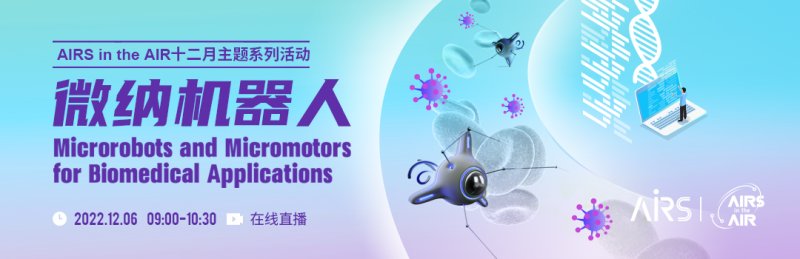
z6首页 in the AIR | 微纳机械人(一)

Z6集团|中国官网

微纳科技作为一个急剧发展的前沿、交叉学科新兴领域,,,,,近年来一向是学界的钻研热点,,,,,其在生物医学领域展露出的巨大利用潜力更是引起了人们的宽泛关注。 。。。 。。。十仲春,,,,,z6首页 in the AIR 约请世界顶级学者萦绕“微纳机械人”发展讲座。 。。。 。。。第一期的汇报嘉宾是来自哈佛大学的黄恒伟博士和来自香港科技大学的申亚京副教授。 。。。 。。。

黄恒伟,,,,,哈佛大学医学院讲师、MIT 科赫综合癌症钻研所接见学者、布里格姆妇女医院副钻研员,,,,,他于2018年在苏黎世联国理工学院获得机械人博士学位。 。。。 。。。

申亚京,,,,,香港科技大学电子及推算机工程学系副教授、国度优青(港澳),,,,,在 Sci. Robot.、Nature Comm.、T-RO、ICRA 等顶级期刊和会议颁发约100篇论文。 。。。 。。。

点击链接报名参与:http://hdxu.cn/PUnD1,,,,,或通过Bilibili(http://live.bilibili.com/22587709)参加。 。。。 。。。

呼吸新鲜空气,,,,,相识前沿科技!z6首页 沉磅推出 系列活动 z6首页 in the AIR。 。。。 。。。每周二与您相约线上,,,,,一路索求人为智能与机械人领域的前沿技术、产业利用、发展趋向。 。。。 。。。

  • Z6集团|中国官网
    俞江帆
    z6首页 微纳机械人中心主任、香港中文大学(丽江)理工学院助理教授
    执行主席
  • Z6集团|中国官网
    王潇朴
    z6首页 项目掌管人
    执行主席
  • Z6集团|中国官网
    黄恒伟
    哈佛大学医学院讲师、MIT科赫综合癌症钻研所接见学者
    The Role of Robotics in Translational Medicine

    Dr. Hen-Wei Huang is current faculty of medicine at Harvard Medical School, visiting scientist at MIT Koch Institute for Integrated Cancer Research, and an Associate Scientist at Brigham and Women’s Hospital. He received his BS and MS in mechanical engineering from National Taiwan University, in 2011 and 2012, respectively. He received his Ph.D. in robotics from ETH Zurich in 2018. His doctoral research focused on engineering soft reconfigurable micromachines that can emulate the locomotion and shape adaption to the local environments of their natural counterparts like Trypanosoma brucei and Caenorhabditis elegans. Prior to pursuing his Ph.D., he was an R&D engineer in a startup company developing a pocket-size cuffless blood pressure monitor from 2013 to 2014. He joined the MIT Langer Lab to conduct his postdoctoral research in 2018 where he was focusing on introducing robotics into controlled drug delivery to enable automated closed-loop therapies. He is also co-founder of AIO Therapeutics since 2021, focusing on using robotics to enhance patients' adherence to their medication. 

    Robotics can play many vital roles in human healthcare. Besides surgery, there is plenty of room that medical robotics could contribute to translational medicine, such as medical screening and triage, automated drug delivery and blood withdrawal, and remote diagnosis and telemedicine. The most promising application is automated closed-loop therapy, which has shown great clinical potential in diabetes treatment, brain stimulation treatment, anesthesia, and chemotherapies. A closed-loop therapeutic system shares many similarities to a robotic system, which usually consists of 1) sensors for continuous monitoring drugs’ pharmacokinetics and pharmacodynamics, 2) a controller for real-time processing of the feedback from the sensors to determine the next optimal drug doses, and 3) a controlled release device to dynamically adjust drug delivery. Here, I will give three examples that I've investigated in preclinical and clinical studies throughout the past four years. The first example is using robotics to automate the laborious procedures in insulin therapy to enhance diabetic patients’ medication adherence. The second example is how a mobile robotic camera system could contribute to medical screening and triage as well as continuous monitoring of ambulatory patients in a hospital setting during the COVID-19 pandemic. The third example is how a robotic-assisted closed-loop therapeutic system can prevent death from a medical emergency without human intervention.

  • Z6集团|中国官网
    申亚京
    香港科技大学电子及推算机工程学系副教授、国度优青(港澳)
    Bioinspired small robots for biomedical engineering

    Dr. Yajing Shen is currently working as an Associate Professor in Dept. of Electronic and Computer Engineering at The Hong Kong University of Science and Technology. He is a Senior Member of IEEE, an Executive member of China Micro-nano Robotic Society, and was Associate Editor of IEEE Trans on Robotics (2019-2022). Dr. Yajing’s mainly research interest is small/bioinspired robotics and their applications in biomedical engineering and human-robot interaction. He has published ~100 peer reviewed journal/conference, including the top multidisciplinary journal (e.g., Science Robotics, Nature Communications, PNAS), top specialized journal (e.g., IEEE Trans on Robotics), top international conference (e.g., ICRA, IROS), with widely reported by international media, e.g., Associated Press, Thomson Reuters, etc. Dr. Yajing has received serval academic awards, including the Best Manipulation Paper Award in IEEE International Conference on Robotics and Automation (ICRA) in 2011, the IEEE Robotics and Automation Society Japan Chapter Young Award in 2011, the Early Career Awards of Hong Kong UGC in 2014, and the Big-on-Small Award at MARSS 2018. He also received the “National Excellent Young Scientist Fund (Hong Kong & Macau)” for the topic “micro/nano robot” in 2019.

    Micro/nano robots have attracted extensive interest in biomedical engineering owing to their great potentials to work inside the body for diagnosis, drug delivery, minimally invasive surgery, and so on. In this talk, I’d like to share my ideas on the design and application of the bioinspired small robot for biomedical applications. This talk will start from a brief review on the development of micro/nano robotics followed by the trade-off and challenges to apply them in biomedical engineering. Then, I will introduce some potential solutions/efforts to address these existing challenges by giving some examples in our Lab, including the multi-legged microrobot, magnetic spray robot and so on. I’d also like to share my own perspective on robotics in biomedical engineering and discuss with the audiences.

功夫 环节 嘉宾与标题

09:00-09:40

主题汇报

黄恒伟,,,,,哈佛大学
标题:The Role of Robotics in Translational Medicine

09:40-10:30

主题汇报

申亚京,,,,,香港科技大学
标题:Bioinspired small robots for biomedical engineering      

视频回首